
Process mapping for your sector
Pick your sector to see where its processes break down and which ones Okty maps first.
Which sector do you work in?

Utilities
A meter reading becomes an invoice through field crews, a control room and billing systems. Each keeps its own steps, and the corrections between them are made by hand.
Common problems
Starting point: Utilities
Field crews, the control room and the back office each run their own version of the same job. Exceptions, such as an estimated reading or an outage, are settled by phone, by the people who have handled them before.
The pressure you work under
Billing and finance
- You see unpaid invoices and DSO, but not where in the process it stalls.
- Corrections and credit notes pass through several teams and tools.
Customer service
- Customers call about estimates and wrong invoices, and you answer without the full picture.
- Every change in a process or tool lands on your team first.
Process owner and IT
- You must approve a process or change a system you only partly see.
- Colleagues work differently from the procedure, and tools serve several processes.
The process
Where meter-to-cash breaks in practice
- 01
Meter reading
Readings arrive from smart meters, field visits and customers, and are validated differently per channel.
- 02Rework
Validation
Estimates and exceptions are corrected by hand, and nobody sees how many.
- 03Rework
Billing run
Runs finish with errors that are fixed afterwards in separate tools.
- 04
Invoice
Invoices go out late or wrong when tariff and contract data are out of sync.
- 05
Payment and collection
Payments are matched to invoices by hand and reminders follow late.
- 06Rework
Disputes and corrections
Disputes pass between customer service, billing and the field, with no clear owner.
Where we start
The processes we map first: Utilities
- 01
Meter-to-cash
Shows where a reading changes hands between systems and teams, and which billing corrections are still made by hand.
- 02
New connections and customer requests
Finds the approval or hand-off each request waits on, and where it stalls between planning, field work and billing.
- 03
Asset inspection and maintenance
Traces how an inspection finding becomes a work order, and which decisions rest on the experience of a few people.
- 04
Outage and incident handling
Shows who is told what and when, and where the control room, crews and customer service fall out of step.
From how work really runs to improvements in place
Four steps, led by our consultants with the AI interviewer and continued by your team in the platform. Verified means checked against every source and approved by the process owner.
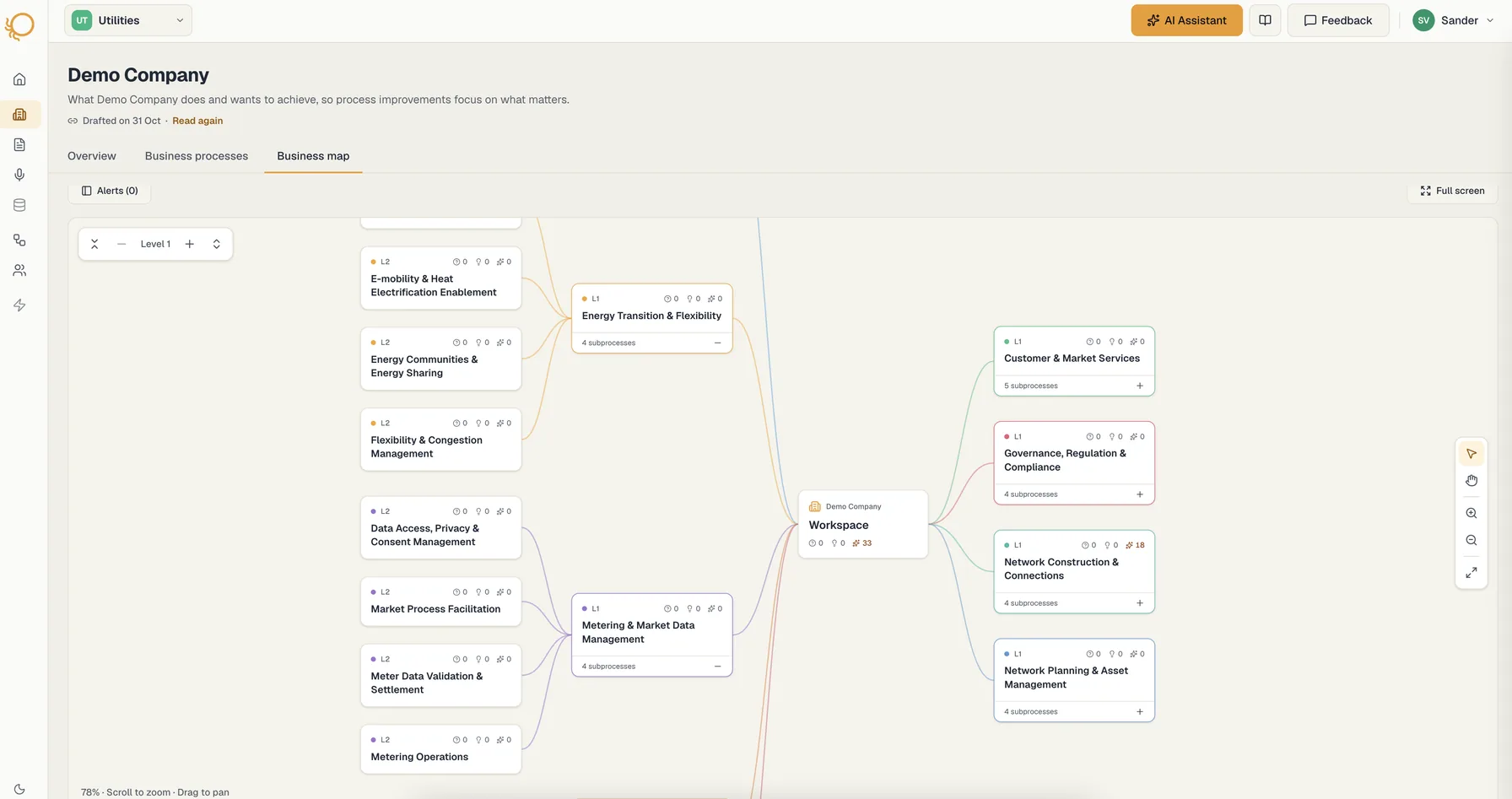
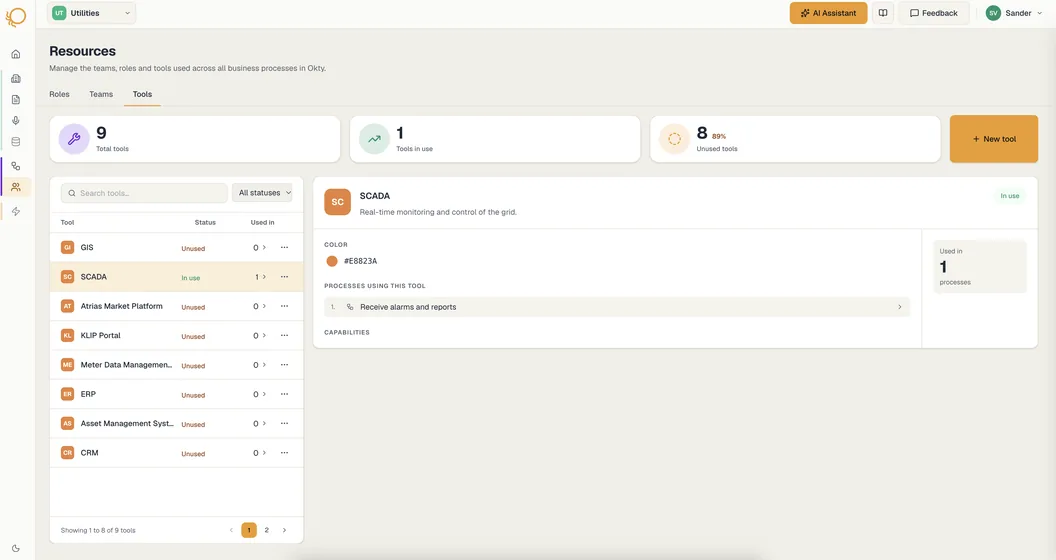
Reads your SOPs, work-order and billing data, and asks crews and planners what the documents miss.
- Input
- Business context, SOPs, wikis and system data
- Result
- A business map and an initial draft of processes
The benefits
What you gain
Today
- Field, control room and back office each keep their own version of a process
- Exceptions are settled by phone and experience, not by a documented step
- Documentation lags behind the systems it describes
With Okty
- Fewer manual corrections between meter reading and invoice
- Faster, more consistent handling of connection requests and outages
- Know-how from experienced staff captured before it leaves
3 weeks
from kickoff to the process map of one full department, checked against your sources, plus a roadmap of improvements
70%
less expensive than consultants on a project, at the top of Okty's price range
4×
as many business users as with consultants on a project, in an estimate for a mid-size department
Time and price depend on the scope of your processes, and both are agreed before we start.
Talk to us about your processes
Manufacturing
An order moves from the ERP to planning to the shop floor, and at each step someone adjusts it by hand. The same order can take a different route on each line.
Common problems
Starting point: Manufacturing
The ERP holds the official order process. On the shop floor, spreadsheets, phone calls and habit cover what the ERP does not, and deviations are handled differently on each line.
The pressure you work under
Finance
- You see DSO and open invoices, but not where in the process it stalls.
- Disputes and credit notes pass through several teams and tools.
Order desk and customer service
- Orders stall on blocks and exceptions, and you take the customers' questions.
- Every change in a process or tool lands on your team first.
Process owner and IT
- You must approve a process or change a system you only partly see.
- Colleagues work differently from the procedure, and tools serve several processes.
The process
Where order-to-cash breaks in practice
- 01
Order intake
Orders arrive by mail, EDI or portal and are entered in different ways.
- 02Rework
Credit check
Orders get stuck on a block and nobody knows who releases them.
- 03
Delivery
The shipping confirmation reaches invoicing late or by hand.
- 04Rework
Invoicing
Invoices go out late or with errors, such as a missing PO reference.
- 05Rework
Disputes and credit notes
Disputes pass between several teams, with no clear owner.
- 06
Payment and collection
Payments are matched to invoices by hand and reminders follow late.
Where we start
The processes we map first: Manufacturing
- 01
Order-to-delivery
Traces the route an order really takes between ERP, planning and the shop floor, and where that route differs from line to line.
- 02
Quality control and non-conformance handling
Shows what happens after a deviation is found, who decides what to do, and where the record is incomplete.
- 03
Maintenance planning
Finds where planned and urgent work compete for the same people, and what really decides the schedule.
- 04
Engineering change management
Traces how a change reaches production, documentation and suppliers, and where the versions drift apart.
From how work really runs to improvements in place
Four steps, led by our consultants with the AI interviewer and continued by your team in the platform. Verified means checked against every source and approved by the process owner.
Reads ERP data and work instructions, and asks line leads where their lines diverge.
- Input
- Business context, SOPs, wikis and system data
- Result
- A business map and an initial draft of processes
The benefits
What you gain
Today
- The same order moves differently from line to line
- Deviations and engineering changes are recorded unevenly
- Maintenance and change work compete for the same people
With Okty
- One agreed way to run order-to-delivery across lines
- Complete, auditable records for deviations and changes
- Less rework and waiting between planning and the floor
3 weeks
from kickoff to the process map of one full department, checked against your sources, plus a roadmap of improvements
70%
less expensive than consultants on a project, at the top of Okty's price range
4×
as many business users as with consultants on a project, in an estimate for a mid-size department
Time and price depend on the scope of your processes, and both are agreed before we start.
Talk to us about your processes
Transport
A dispatcher plans the day, and then it changes: a delay, a breakdown, a customer call. The changes reach drivers by phone and message, not through the planning system.
Common problems
Starting point: Transport
Dispatch, fleet maintenance and compliance each work in their own system and with their own parties: customers, drivers, workshops and authorities.
The pressure you work under
Operations planner
- Plans change by the hour, and the reasons live in people's heads.
- Last-minute changes reach drivers by phone and message.
Customer service and account managers
- Customers ask where a shipment is, and the answer sits in three systems.
- Every change in a process or tool lands on your team first.
Process owner and IT
- You must approve a process or change a system you only partly see.
- Colleagues work differently from the procedure, and tools serve several processes.
The process
Where shipment-to-invoice breaks in practice
- 01
Booking
Bookings arrive by mail, portal and phone and are entered in different ways.
- 02Rework
Route planning
Plans rest on the planner's habits, and changes are passed on by phone.
- 03
Dispatch
Drivers and subcontractors get instructions through several channels.
- 04
Delivery
Proof of delivery reaches the back office late or on paper.
- 05Rework
Documents and customs
Documents are corrected by hand at each border or hand-over.
- 06Rework
Invoicing
Invoices wait for missing documents, and surcharges are added afterwards.
Where we start
The processes we map first: Transport
- 01
Dispatch and route planning
Shows which rules and habits shape the daily plan, and how last-minute changes reach the drivers.
- 02
Fleet and vehicle maintenance
Traces how a fault reported by a driver reaches the workshop, and where the downtime could have been planned.
- 03
Shipment documentation and customs
Finds which documents each border or hand-over requires, and where they are still corrected by hand.
- 04
Delay and incident handling
Shows how exceptions are resolved today, and which of those fixes could become a defined step.
From how work really runs to improvements in place
Four steps, led by our consultants with the AI interviewer and continued by your team in the platform. Verified means checked against every source and approved by the process owner.
Reads planning data and shipment documents, and asks dispatchers and drivers how exceptions are handled.
- Input
- Business context, SOPs, wikis and system data
- Result
- A business map and an initial draft of processes
The benefits
What you gain
Today
- Last-minute changes travel by phone and message, not by process
- Documents are corrected by hand at every hand-over
- Exceptions are solved case by case and rarely reused
With Okty
- Fewer last-minute surprises passed on by phone
- Cleaner shipment documents and fewer manual corrections at borders
- Shorter downtime through planned, repeatable maintenance steps
3 weeks
from kickoff to the process map of one full department, checked against your sources, plus a roadmap of improvements
70%
less expensive than consultants on a project, at the top of Okty's price range
4×
as many business users as with consultants on a project, in an estimate for a mid-size department
Time and price depend on the scope of your processes, and both are agreed before we start.
Talk to us about your processes
Health
A patient moves between admission, wards, referrals and discharge. Each step is documented on its own, so the same information is entered again in each department.
Common problems
Starting point: Health
Clinical care follows written protocols. The administration around it, from admission and referrals to scheduling, billing and supplies, runs across departments and systems and is documented far less.
The pressure you work under
Administration and billing
- Claims come back for missing data, and you correct them by hand.
- Rejections and disputes have no clear owner between departments.
Care coordination
- You plan appointments across several systems and calendars.
- The same patient data is entered again in each department.
Process owner and IT
- You must approve a process or change a system you only partly see.
- Colleagues work differently from the procedure, and tools serve several processes.
The process
Where referral-to-reimbursement breaks in practice
- 01Rework
Referral
Referrals arrive by letter, portal and phone and are checked by hand.
- 02
Scheduling
Appointments are planned across several systems and calendars.
- 03Rework
Admission
The same patient data is entered again in each department.
- 04
Treatment record
Administrative notes and codes are completed after the visit.
- 05Rework
Billing
Claims are returned for missing data and corrected by hand.
- 06
Reimbursement follow-up
Rejections and disputes have no clear owner between departments.
Where we start
The processes we map first: Health
- 01
Patient admission and discharge
Finds the steps that repeat across departments, and where the same information is entered more than once.
- 02
Referrals and scheduling
Traces how a referral becomes an appointment, and where it waits for a manual check.
- 03
Billing and reimbursement
Shows where missing data sends a claim back, and who has to correct it.
- 04
Medical supply and stock handling
Traces how stock is requested, checked and replenished between the wards and the central store.
From how work really runs to improvements in place
Four steps, led by our consultants with the AI interviewer and continued by your team in the platform. Verified means checked against every source and approved by the process owner.
Reads protocols and department procedures, and asks admissions and billing staff where entries repeat.
- Input
- Business context, SOPs, wikis and system data
- Result
- A business map and an initial draft of processes
The benefits
What you gain
Today
- The same information is entered in more than one place
- Referrals and claims wait for manual checks
- Supply requests follow local habits, ward by ward
With Okty
- Less double entry for clinical and administrative staff
- Fewer claims returned for missing data
- Steadier supplies across wards and the central store
3 weeks
from kickoff to the process map of one full department, checked against your sources, plus a roadmap of improvements
70%
less expensive than consultants on a project, at the top of Okty's price range
4×
as many business users as with consultants on a project, in an estimate for a mid-size department
Time and price depend on the scope of your processes, and both are agreed before we start.
Talk to us about your processes
Insurance
A claim passes from intake to assessment to payment. The written procedure covers the standard case, and the exceptions are decided by the handlers, from experience.
Common problems
Starting point: Insurance
Claims arrive by mail, email and portal, and each handler decides which documents to ask for. Underwriting rules sit partly in a handbook and partly with the senior underwriters.
The pressure you work under
Claims management
- Handlers apply the same rule in different ways.
- Complaints loop back because cases are classified inconsistently.
Underwriting and servicing
- Change requests are re-keyed between channels and systems.
- The rules that matter most are not written down.
Process owner and IT
- You must approve a process or change a system you only partly see.
- Colleagues work differently from the procedure, and tools serve several processes.
The process
Where claim-to-settlement breaks in practice
- 01
Claim intake
Claims arrive by mail, phone and portal and are registered in different ways.
- 02Rework
Triage
Routing depends on who sees the claim first.
- 03
Assessment
Handlers ask for documents the customer already sent.
- 04Rework
Decision
The same rule is applied differently, and exceptions are approved informally.
- 05
Payout
Payments wait for manual checks between claims and finance.
- 06Rework
Complaints and disputes
Complaints are classified inconsistently and cases loop back.
Where we start
The processes we map first: Insurance
- 01
Claims intake and handling
Shows how a claim is routed, which documents are asked for, and where handlers rely on their own judgement.
- 02
Underwriting and policy issuance
Finds which underwriting rules are written down and which live in people's heads, and who approves the exceptions.
- 03
Policy changes and renewals
Traces how a change request moves between channels and systems, and where it is typed in again.
- 04
Complaint and dispute handling
Shows how a complaint is classified and escalated, and which cases cycle back.
From how work really runs to improvements in place
Four steps, led by our consultants with the AI interviewer and continued by your team in the platform. Verified means checked against every source and approved by the process owner.
Reads guidelines and policy system data, and asks handlers to write down the rules that live in their heads.
- Input
- Business context, SOPs, wikis and system data
- Result
- A business map and an initial draft of processes
The benefits
What you gain
Today
- Handlers apply the same rule in different ways
- Change requests are re-keyed between channels and systems
- Complaints cycle back because classification is inconsistent
With Okty
- More consistent decisions on claims and exceptions
- Less re-keying between channels and policy systems
- Fewer complaints that loop back for rework
3 weeks
from kickoff to the process map of one full department, checked against your sources, plus a roadmap of improvements
70%
less expensive than consultants on a project, at the top of Okty's price range
4×
as many business users as with consultants on a project, in an estimate for a mid-size department
Time and price depend on the scope of your processes, and both are agreed before we start.
Talk to us about your processes
Other industries
Any organisation where work passes through several teams, approvals and systems has the same gap between the written process and the one that runs: banks, public bodies, retail, telecom, professional services.
Common problems
Starting point: Other industries
Whatever the industry, work that passes through several teams, approvals and systems ends up in two versions: the written process, and the one people follow to get things done. The gap between them is where time and money are lost.
The pressure you work under
Operations and team leads
- You run the work every day, and the reasons behind a workaround live in people's heads.
- A change in one team lands on yours without warning.
Finance and risk
- You see the cost and the exceptions, but not where in the process they come from.
- Controls exist on paper, and you cannot tell if they are followed.
Process owner and IT
- You must approve a process or change a system you only partly see.
- Colleagues work differently from the procedure, and tools serve several processes.
The process
Where request-to-completion breaks in practice
- 01
Request or intake
Requests arrive by email, form or phone, and are entered in different places.
- 02Rework
Triage and assignment
Who takes a request depends on who is available and who knows the case, not on a rule.
- 03
Information gathering
The same documents and data are asked for again by each team.
- 04Rework
Approval
Approvals wait on one person, or are asked for out of habit when the rules do not require them.
- 05Rework
Execution
The work is done in several systems, with data copied by hand between them.
- 06
Closure and follow-up
Cases are closed without feedback, so repeated problems are not recognised.
Where we start
The processes we map first: Other industries
- 01
Requests and approvals
Finds who each request waits on, which approvals are only habit, and where it stalls between teams.
- 02
Customer or employee onboarding
Finds the steps that repeat across teams and systems, and where the same information is entered again.
- 03
Incidents, complaints and exceptions
Shows how a case is classified and escalated, and which ones cycle back.
- 04
Handovers between teams and partners
Shows what is passed on, in which form, and what gets lost on the way.
From how work really runs to improvements in place
Four steps, led by our consultants with the AI interviewer and continued by your team in the platform. Verified means checked against every source and approved by the process owner.
Reads your procedures, policies and system data, and asks the people who do the work what the documents miss.
- Input
- Business context, SOPs, wikis and system data
- Result
- A business map and an initial draft of processes
The benefits
What you gain
Today
- The written procedure covers the standard case, and exceptions are decided by whoever knows best
- The same information is entered again in each team and system
- Nobody can say how long a request really takes, or why it stalls
With Okty
- One agreed way of working across teams, instead of one per team
- Fewer repeated entries and approvals that only exist out of habit
- Know-how from experienced staff captured before it leaves
3 weeks
from kickoff to the process map of one full department, checked against your sources, plus a roadmap of improvements
70%
less expensive than consultants on a project, at the top of Okty's price range
4×
as many business users as with consultants on a project, in an estimate for a mid-size department
Time and price depend on the scope of your processes, and both are agreed before we start.
Talk to us about your processes
Partners
Okty works with consultancy, transformation and software partners. They share one verified picture of how the work really runs, so the advice, the programme and the build rest on the same facts.
Common problems
Starting point: Partners
In a transformation, a consultancy advises, a transformation team runs the programme and software partners build. When each works from its own picture of the process, a lot of effort goes into reconciling them. With Okty, they start from the same one.
The pressure you work under
Consultancy partner
- You advise on a picture you had to build yourself, in workshops.
- Your findings are only as current as the last report.
Transformation partner
- You plan the programme from documents that disagree.
- Every party reports its own state of the work.
Software partner
- You receive requirements that are missing the exceptions.
- You find the real process out during the build.
The process
Where discovery-to-delivery breaks in practice
- 01Rework
Discovery
Each party interviews the same people, and the answers sit in separate notes.
- 02
Process picture
The process map is drawn from workshops and ages as soon as it is done.
- 03
Prioritisation
Improvements are ranked on opinion, and each party ranks differently.
- 04Rework
Requirements
Findings become requirements by hand, and the exceptions get lost.
- 05
Build
The real process is discovered during the build, and the scope changes.
- 06Rework
Handover
Nobody owns the process map once the project team leaves.
Where we start
The processes we map first: Partners
- 01
Joint discovery
Shows what each party has already asked, and where the same people are interviewed again.
- 02
Hand-over of requirements
Traces how a finding becomes a requirement for the software partner, and what is lost on the way.
- 03
Programme tracking
Finds where plans, decisions and the real state of the work drift apart between parties.
- 04
Process ownership after go-live
Shows who keeps the process map current once the project team has left.
From how work really runs to improvements in place
Four steps, led by our consultants with the AI interviewer and continued by your team in the platform. Verified means checked against every source and approved by the process owner.
Reads each party's documents and system data once, and asks the people who do the work what they miss.
- Input
- Business context, SOPs, wikis and system data
- Result
- A business map and an initial draft of processes
The benefits
What you gain
Today
- The same people are interviewed by each party in turn
- Findings travel between parties as slides and documents, and lose detail
- Nobody owns the process picture once the project ends
With Okty
- One process picture shared by every party
- Fewer repeated interviews and workshops
- A map that stays current after the project team has left
3 weeks
from kickoff to the process map of one full department, checked against your sources, plus a roadmap of improvements
70%
less expensive than consultants on a project, at the top of Okty's price range
4×
as many business users as with consultants on a project, in an estimate for a mid-size department
Time and price depend on the scope of your processes, and both are agreed before we start.
Talk to us about your processesSee Okty applied to one of your processes
Bring an SOP or run a live AI interview, and we build the process map on your own example and show which improvements it points to.
What happens in the session